Rational Equation Solving
Rational Equation Solving. Multiply both sides of the equation by the least common denominator (lcd). An extraneous solution to a rational equation is an algebraic solution that would cause any of the expressions in the original equation to be undefined.
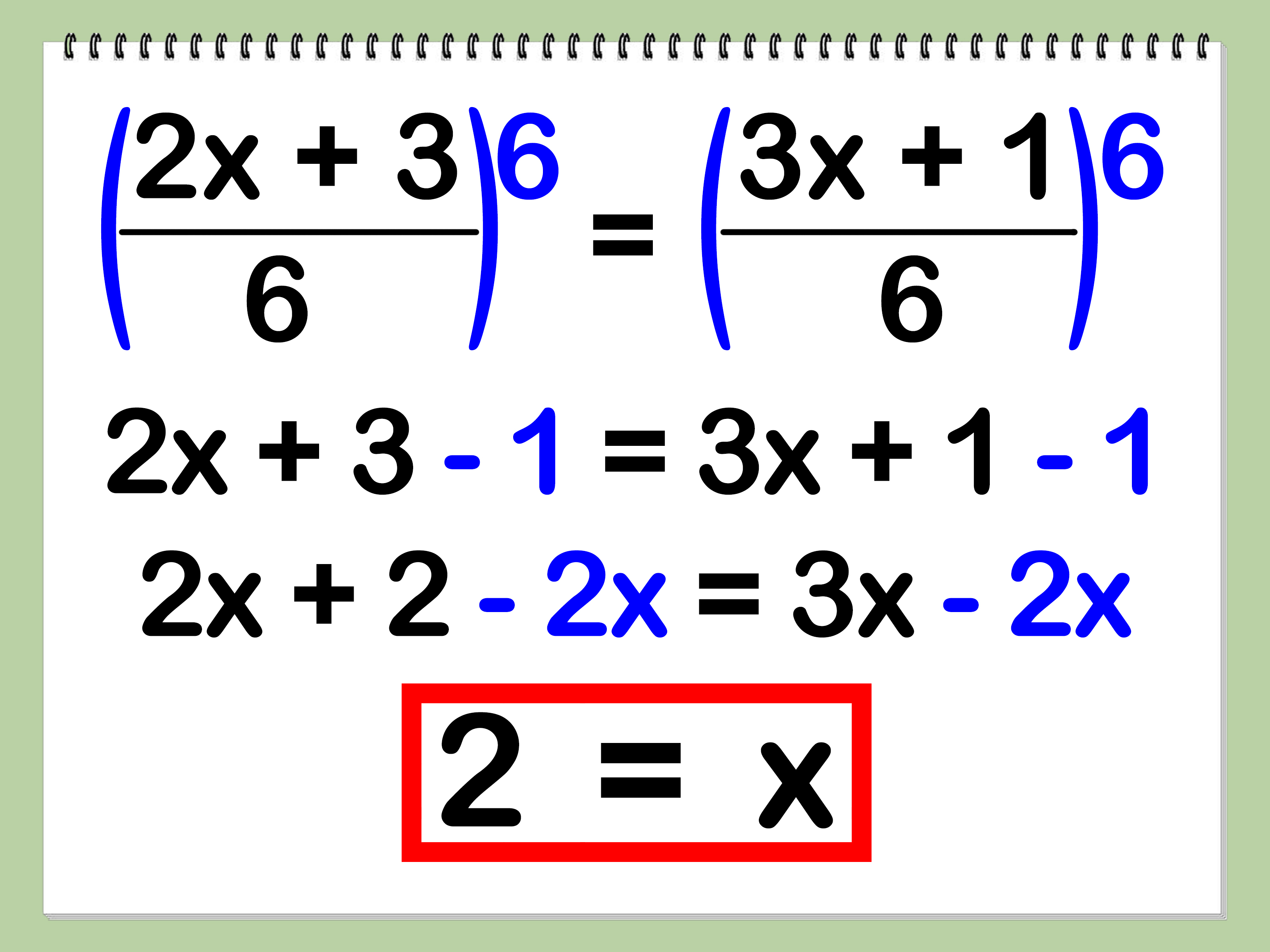
Practice your math skills and learn step by step with our math solver. 4 1 4 3 16. A rational equation is an equation containing at least one fraction whose numerator and denominator are polynomials, \frac {p (x)} {q (x)}.
Like Normal Algebraic Equations, Rational Equations Are Solved By Performing The Same Operations To Both Sides Of The Equation Until The Variable Is Isolated On One Side Of The Equals Sign.
5 9 4 3 1 x + = 2. When we have an equation where the variable is in the denominator of a quotient, that's a rational equation. How to solve rational equations step 1:
Distribute Carefully And Then Simplify.
How to solve equations with rational expressions example 7.6. This algebra video tutorial explains how to solve rational equations by eliminating all fractions by multiplying both sides of the equation by the least comm. 1 x + 1 3 = 5 6.
You Must Check All Answers.
Recall that you can solve equations containing fractions by using the least common denominator of all the fractions in the equation. X^ {\msquare} \log_ {\msquare} \sqrt {\square} \nthroot [\msquare] {\square} \le. Then multiply both sides by the lcd.
An Equation Involving Rational Expressions Is Called A Rational Equation.
Solve equations with rational expressions. (note that i'm not saying that solving rational equations is simple; We note any possible extraneous solutions, c, by writing x ≠ c next to the equation.
Procedure Of Solving The Rational Equations:
Google classroom facebook twitter email sort by: Solving rational equations examples 1. Here the result is a quadratic.